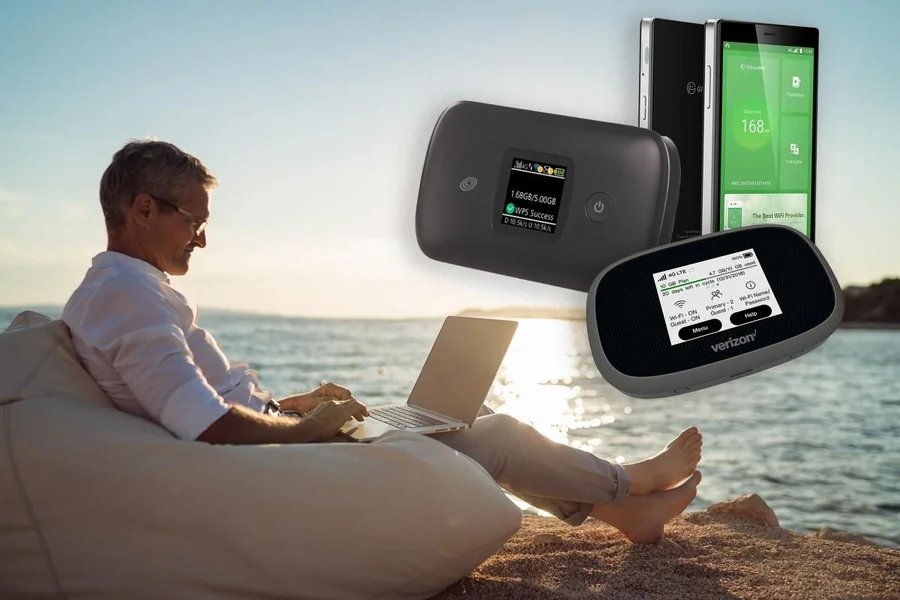
You have a long road trip with your friends coming up, and your manager just told you that you have to deliver an important document on the day you are traveling. Despite trying everything, you are unable to work on it beforehand because your workload is sky-high. So, you resign to the fact that you will have to work while you are on your way to the destination and miss out on all the fun with your friends.
However, you do not only need your laptop for working on the go. You need a stable internet connection so that you can access all the cloud tools.
For this, you find yourself at a crossroads between a portátil (portable) WiFi router and a mobile hotspot. You do not know which one will be suitable for your connectivity needs.
To help you make an informed choice and to prevent you from ending up with an unsuitable option, let’s delve deep into both portable WiFi and mobile hotspots to find their strong and weak points.
Getting the Basics First
While both provide wireless internet connectivity, they greatly differ in how they function.
· Mobile Hotspot
Also called mobile phone tethering, a mobile hotspot is when your phone distributes its internet data (4G LTE or 5G). It acts as a router and you can connect other devices to get them internet connectivity. This connection between your phone and other devices is called a tether. This can be wireless or even wired using a USB cable.
However, the wireless phone tethering feature, or hotspot, is readily available in all smartphones and is a popular method of creating a tether.
All you have to do is go to your phone’s Connection Settings to toggle on the Mobile Hotspot. Then you switch on the WiFi option on your other devices to find your phone’s tethering, which is available as WiFi.
However, an inalámbrico (wireless) 4G LTE or 5G connection is an important prerequisite for creating a hotspot. If your phone does not have cellular internet connectivity, then it cannot provide the same to other devices
· Portable WiFi
Portable WiFi also functions on 4G LTE or 5G mobile data, but for that, you do not need your phone. Instead, you get a portable router, which is a small handheld device that catches the data from a nearby cellular tower and converts it into a WiFi signal for your devices.
Portable WiFi devices give off wireless señales (signals) just like the router at your home. So, all you have to do is find its WiFi network on your other devices and connect to it to get instant internet connectivity.
However, this kind of WiFi is not as convenient as your mobile tethering. You have to sign up for these separately, choose a plan, and then get the device.
Areas of Strength
Both wireless internet options have their own areas of strength.
Mobile Hotspot wins in terms of ease of access. You most likely have already subscribed to a cellular data plan. So, all you have to do is use your phone to create a tethering connection, and Voilà! You are all set to access internet connectivity on other devices.
Moreover, mobile hotspots are also affordable in the sense that cellular data is already included in phone packages. So, you do not have to separately pay for an expensive plan. You can use this data for your tethering to power other devices.
As far as Mobile WiFi is concerned, it wins in terms of capacity. Since it is built to provide conectividad (connectivity) to other devices, unlike our smartphones. This is why it has sophisticated technology that can easily handle 30+ devices, without causing any lag.
It also provides better and consistent connectivity due to its hardware that can easily catch signals from far away and distribute them better. This means it can easily handle high-bandwidth activities better than mobile tethering.
Weak Sides
Mobile hotspots are not strong enough to support multiple devices, especially if you want uninterrupted connectivity. This can severely affect your en línea (online) activities on the go. Moreover, constant usage can quickly drain your phone battery.
Where portable WiFi is concerned, it can cost more than a mobile hotspot because you have to separately get the device and subscribe to a plan. Moreover, these mostly have data caps, which means you will have to carefully use it.
Mobile Hotspot vs. Portable WiFi: Final Verdict
While both have their points of strength and weakness, I will recommend a mobile hotspot if you have a short road trip and you are sure that other people won’t use your internet. I have an Xfinity mobile plan, and the cellular data works fine to support my connectivity needs for short commutes. Moreover, in case of an unprecedented dip in the service, the Xfinity servicio al cliente is always a call away.
Otherwise, if you have a long road trip and more people will want internet connectivity, then you can invertir (invest) in a portable WiFi, as you will get excellent value for money. Providers like AT&T and Verizon have great plans that can support your connectivity needs on the go.

I’m Owais Ahmed, the creator of DailyMessagez.com — a place where emotions find words. With a passion for writing and expertise in SEO, I craft heartfelt messages that not only connect with readers but also reach the right audience. My goal is to inspire love, gratitude, and positivity through every line.